
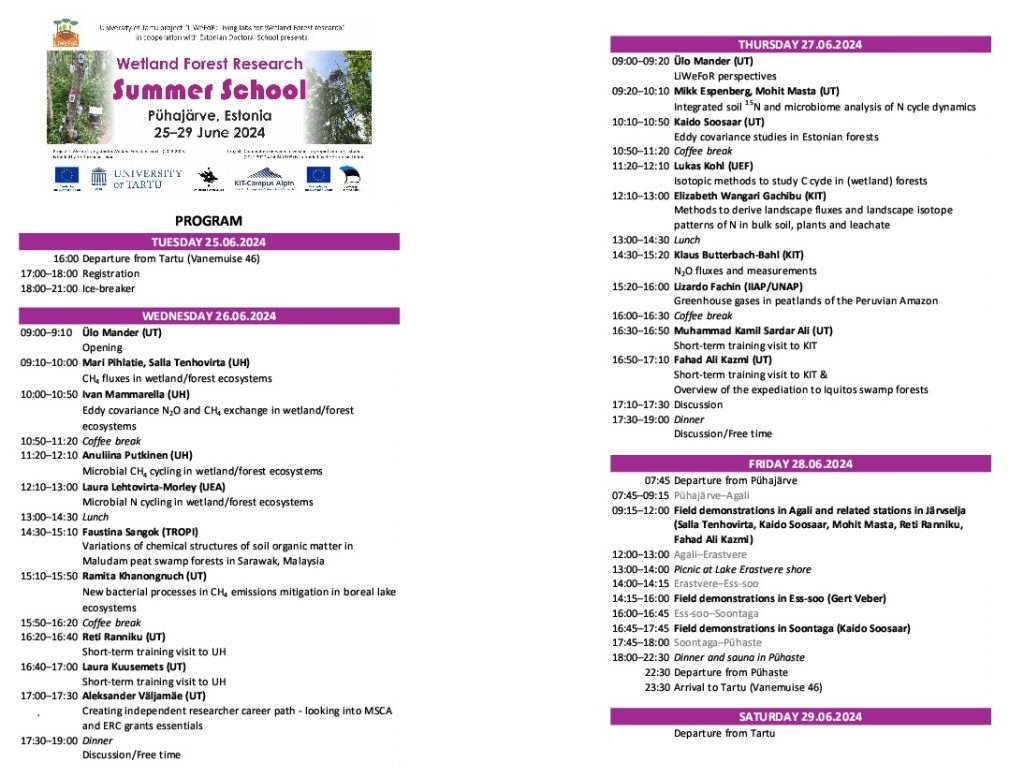
Program
The LiWeFoR Wetland Forest Research Summer School brought together the three LiWeFoR partners, University of Tartu (UT), University of Helsinki (UH), Karlsruhe Institute of Technology (KIT), as well as mutual collaborators from Research Institute of the Peruvian Amazon (IIAP)/National University of the Peruvian Amazon (UNAP), Sarawak Tropical Peat Research Institute (TROPI), and guest scholars from University of Eastern Finland (UEF) and University of East Anglia (UEA), UK, studying wetland forests and GHGs. During the event, skills, knowledge, and stories were shared on carbon and nutrient fluxes in swamp and bog forests worldwide.
The UT team invited the Estonian Doctoral School to serve as an event partner, broadening the audience of PhD students from other Estonian universities and sharing the experience of the LiWeFoR team. Therefore, PhD students from the Estonian University of Life Sciences (EMÜ) and Tallinn University of Technology (TalTech) were represented.
The Summer School was held in scenic Pühajärve, South Estonia (Pühajärve Hotel and Conference Centre, https://www.pyhajarve.com/en/conference-centre) during 25–29 June 2024 (incl. arrival and departure dates).
The event was advertised on the LiWeFoR web page: https://LiWeFoR.geo.ut.ee/news/ as well as on the Estonian Doctoral School web page: https://www.doktorikool.ee/et/uritused/LiWeFoR-wetland-forest-research-summer-school/, and via both mailing lists, respectively.


The excursion route of the LiWeFoR Summer School, starting from Pühajärve (1), demonstrations and discussions (2–6), and ending in Tartu (7).
Prof. Klaus Butterbach-Bahl (KIT), Prof. Mari Pihlatie and Dr. Salla Tenhovirta (both UH), and Prof. Ülo Mander, Dr. Kaido Soosaar, Dr. Mohit Masta, Dr. Reti Ranniku, Dr. Gert Veber, and Fahad Ali Kazmi (all UT) were responsible for the demonstrations, with discussions encompassing all participants of the Summer School.
Various experimental approaches were shown and discussed at the LiWeFoR site of the drained birch peat swamp forest in Agali. Changes in drainage regime and nutrient availability from ditching and damming were discussed. Flooding, drying, and warming experiments were introduced. Among the methods discussed were manual and automatic soil chambers, stem chambers, and eddy covariance, as well as soil microbial analysis, isotopes, and labelled nitrogen. Eddy covariance techniques for CO2, CH4, and N2O exchange were further presented and discussed at the SMEAR Estonia station in a peaty pine swamp forest in Järvselja and a dry pine forest station in Soontaga. Research needs for further studies on the allocation of carbon fluxes between ecosystem components (soil, rhizosphere, stem, canopy space, and total ecosystem) were outlined. The Free Air Humidity Manipulation (FAHM) experimental station was established in seasonally wet young hybrid aspen and birch forests in Rõka. The discussions focused on changes in carbon and nutrient cycling in the forest ecosystem.
Various peatland restoration experiments were introduced at the Ess-soo former bog peat extraction area. Variable success of different restoration methods and their combinations was observed. Mobile and stationary techniques of carbon exchange and partitioning between gross and net exchanges were introduced. Critical soil moisture and nutrient (phosphorus and nitrogen) levels for the re-establishment of Sphagnum moss growth were discussed.

Introducing peatland restoration experiments in Ess-soo, Estonia. Credits: J. Pärn
Gallery


